Hi everyone,

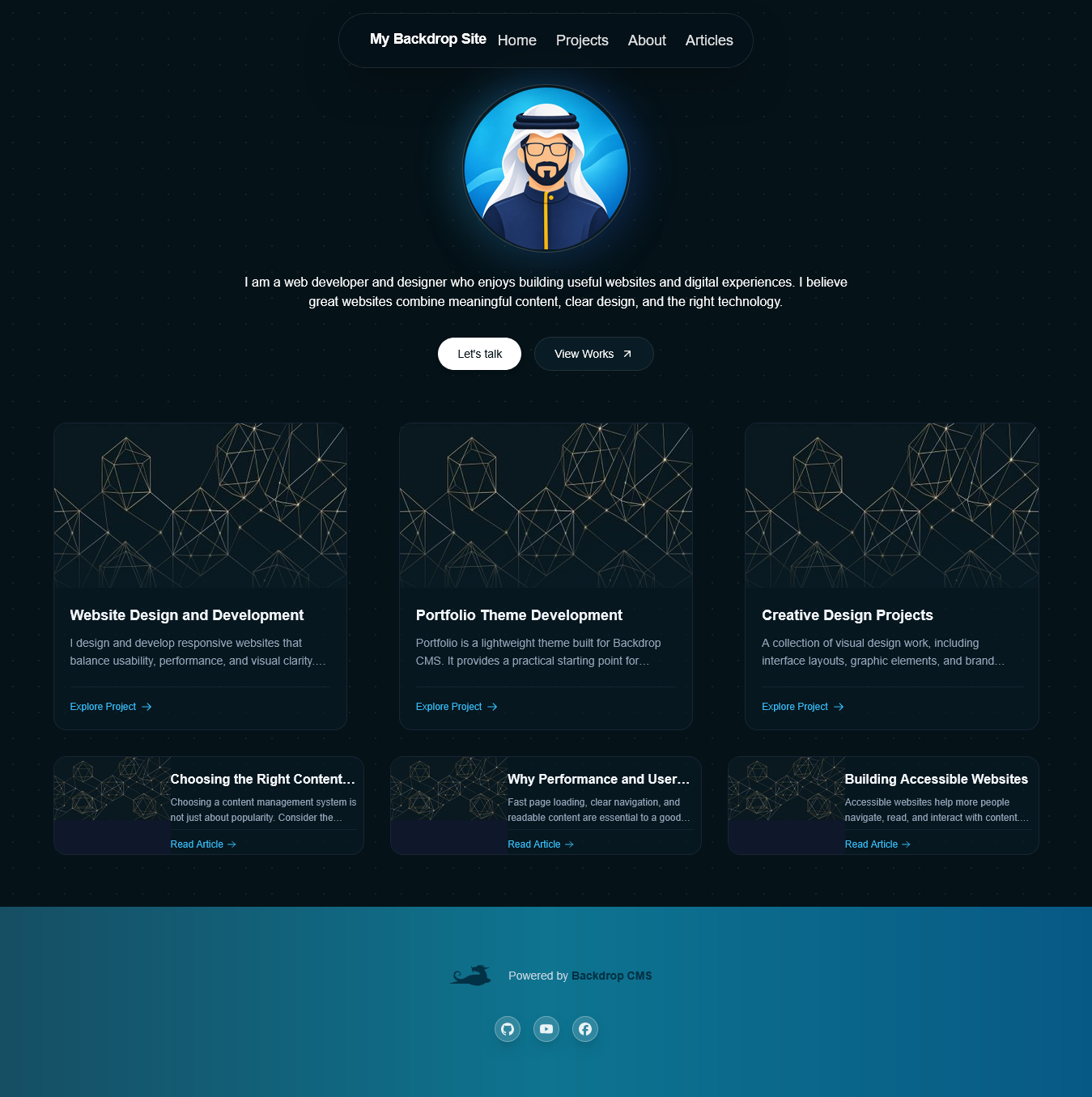
I'd like to share Portfolio, a free, responsive portfolio theme I've been working on for Backdrop CMS.

The theme is designed for personal websites, developers, designers, and freelancers.

Key features:

  • Responsive design using Tailwind CSS.
  • Customizable theme appearance settings.
  • Optional import of sample content, taxonomy terms, and menu links.
  • Preconfigured Views blocks for personal information, projects, and articles.
  • Home Layout configuration.
  • Custom taxonomy pages for projects and articles.
  • Support for both RTL and LTR .

The theme is currently available on GitHub:

https://github.com/shabib-m/portfolio

I'd appreciate any feedback, suggestions, or testing from the community before submitting it for inclusion in Backdrop Contrib.

Thanks!
Most helpful answers

I wouldn't say lazy; I think it comes down to preference: some people really like Tailwind's approach and others do not.

Probably a lot to do with how our brains work and the logic we apply when designing a site.

I found this quite informative when I was researching what Tailwind was:

https://en.andros.dev/blog/af3ee191/why-i-dont-recommend-tailwind-css/

I found this when I was drilling into the question of how Tailwind impacts on semantic HTML and the separation between content and design.  The author covers the different arguments.

I am sure there will also be many articles that will explore the various arguments and decide that they do recommend Tailwind.

For me, I prefer a combination of Sass (SCSS) and native CSS variables to maximise reusability.

What I appreciate is that @shabib has made sure that these themes will work out of the box, which adds to what is available for site builders who don't want to get into custom theming. This is a valuable contribution to Backdrop, but it won't be useful for everyone.

Comments

ADMIN EDIT: Image below is link to YouTube video

Installation Video

EDIT: Video link not working

BKaernel's picture

How do you manage to keep track of so many classes? Wouldn't it be simpler to keep the CSS in its own separate file, rather than having it mixed in with the HTML?

class="absolute top-16 right-0 left-0 bg-[#091b24]/95 backdrop-blur-xl border-b border-white/10 shadow-2xl py-4 px-6 flex flex-col gap-4 transform -translate-y-full opacity-0 pointer-events-none transition-all duration-300 peer-checked:translate-y-0 peer-checked:opacity-100 peer-checked:pointer-events-auto md:hidden"

That's how Tailwind CSS works. In the end, it generates a smaller CSS file compared to other approaches.

BKaernel's picture

Compare to the basic approach (without framework or with a very basic one), i think the difference is not that big.

And with a simply approach no need to learn thousands of classes to make css. It saves time and simplicity in your html. 

Maybe because I’m lazy?

I wouldn't say lazy; I think it comes down to preference: some people really like Tailwind's approach and others do not.

Probably a lot to do with how our brains work and the logic we apply when designing a site.

I found this quite informative when I was researching what Tailwind was:

https://en.andros.dev/blog/af3ee191/why-i-dont-recommend-tailwind-css/

I found this when I was drilling into the question of how Tailwind impacts on semantic HTML and the separation between content and design.  The author covers the different arguments.

I am sure there will also be many articles that will explore the various arguments and decide that they do recommend Tailwind.

For me, I prefer a combination of Sass (SCSS) and native CSS variables to maximise reusability.

What I appreciate is that @shabib has made sure that these themes will work out of the box, which adds to what is available for site builders who don't want to get into custom theming. This is a valuable contribution to Backdrop, but it won't be useful for everyone.

Thank you, @yorkshirepudding, for your thoughtful feedback and kind words!

I completely agree that everyone has their own preferences and workflow. Frameworks are simply tools designed to make our work easier.

My goal is to help theme designers create ready-to-use themes with simple tools, without having to write PHP code or dig through Backdrop APIs to configure everything for the end user.

Thanks again for your encouragement!

 not lazy at all! 😄

Tailwind generates a CSS file containing only the styles used in the project, helping keep it small. It also makes development and maintenance easier for web designers by providing consistent, reusable utility classes.

I prefer Tailwind because it fits my workflow, I hope you'll give Tailwind CSS a try. 😊

BKaernel's picture

Honestly, no. My brain isn't configured for this kind of thing :-)

😄 I just hope your brain noticed what the theme can do with sample content. If not, we might have a bigger problem ! 

Why were CSS frameworks created in the first place? Wasn't the goal to make web design easier and save developers time?

At the end of the day, frameworks are just tools we use when we need them.

I used Bootstrap for years, like many other web designers, before switching to Tailwind CSS. One reason was that Tailwind allows me to generate a CSS file containing only the utilities used in my project, instead of including a large collection of styles I don't need.

Does that mean I've stopped writing custom CSS? Of course not! I still use it whenever necessary. You can see that in the theme's `style.css` file.

And maintenance isn't just about managing CSS classes. One of the biggest challenges in web design is dealing with different screen sizes, browsers, and rendering engines.

Should I track every browser engine and its updates myself to fix compatibility issues?

That's another reason I prefer using a well-maintained framework. I can benefit from its documentation, updates, and community solutions instead of solving every issue on my own.

Of course, a framework doesn't eliminate all compatibility problems, but it can make dealing with them much easier.